
Railroad welding fumes exposure and cancer
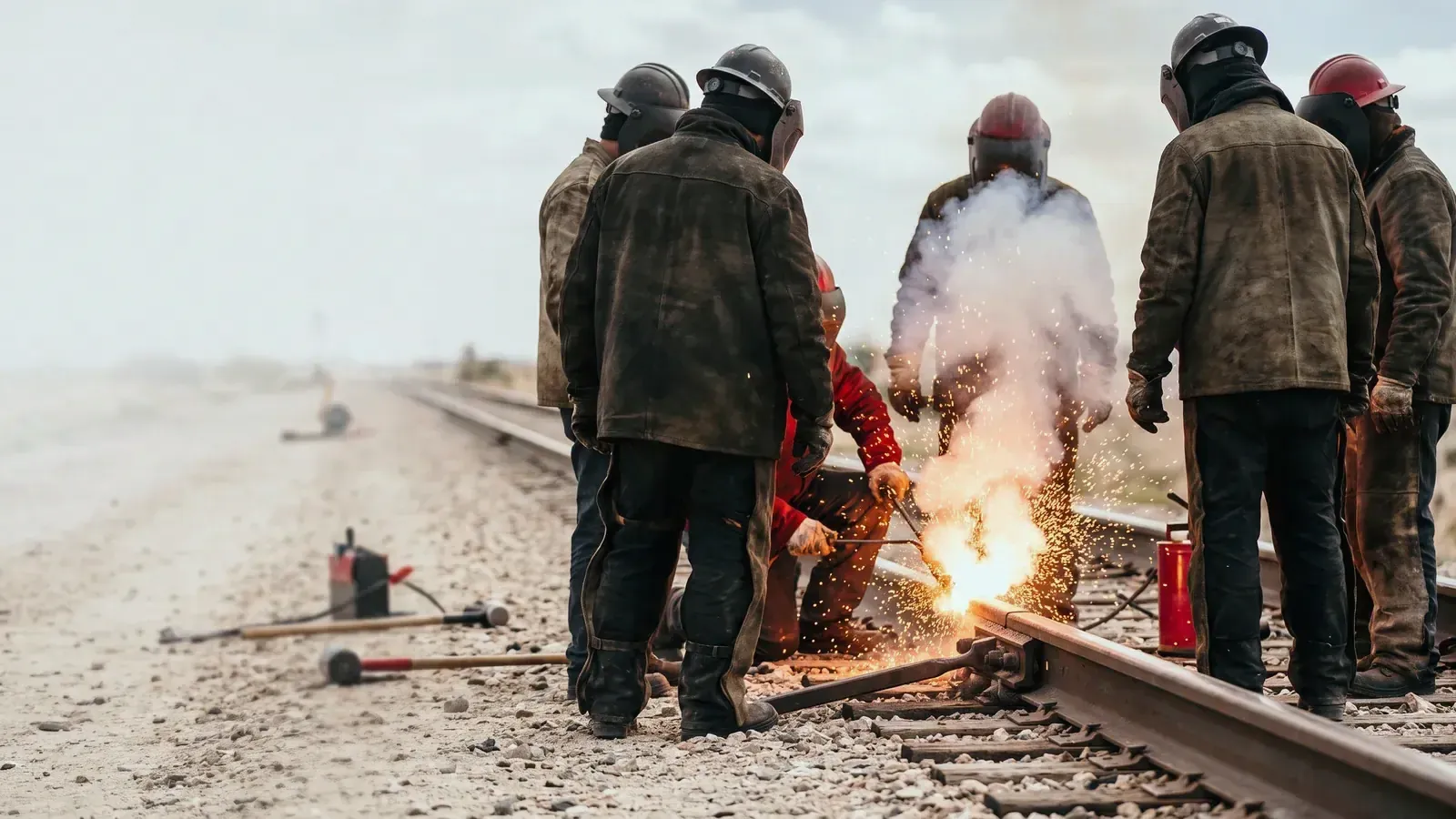
If you welded on the railroad, or worked next to someone who did, your railroad welding fumes exposure matters, because the World Health Organization's cancer agency says these fumes cause lung cancer. If you breathed it on a railroad job and the railroad's carelessness played any part in your illness, federal law lets you hold the railroad responsible. IARC, the World Health Organization's cancer agency, puts welding fume in Group 1, its top category, which means the proof that it causes cancer in people is solid, as one review of the IARC findings explains. How much fume a worker breathed depended on the welding process, ventilation, and how the work was done.
Call +1 (888) 716-2611 Free FELA claim review if this was part of your railroad work
What is in welding fume?
The smoke you can see rising off a weld is made of tiny metal particles and gases. Those particles measure less than one micrometer across, much too small to see by themselves, as IARC noted. Welding fumes are a known cause of lung cancer.
Among the metals that can turn up in the fume, OSHA's welding fact sheet names arsenic, beryllium, cadmium, chromium, and nickel. Welding converts chromium into hexavalent chromium, a highly toxic form that can cause cancer and harms the eyes, skin, nose, throat, and lungs.
A worker's dose depended on the welding process used, whether local exhaust ventilation was in place, and how the job was carried out. New welders or those with little training may have been exposed to higher levels, according to the IARC review.
How scientists rated welding fume
In March 2017, seventeen scientists from ten countries gathered at IARC to decide if welding, plus two related chemicals, can cause cancer. Their summary appeared in The Lancet Oncology under the date April 10, 2017, and the complete findings make up IARC Monographs Volume 118.
| Substance | IARC group | Group meaning |
|---|---|---|
| Welding fume | Group 1 | Known to cause cancer in people |
| UV radiation from welding | Group 1 | Known to cause cancer in people |
| Molybdenum trioxide | Group 2B | Possibly cancer-causing in people |
| Indium tin oxide | Group 2B | Possibly cancer-causing in people |
Since 1989, welding fume had sat at Group 2B, only possibly cancer-causing. The upgrade to Group 1 came from substantial new evidence drawn from worker studies and laboratory research, as IARC explained.
The clearest results were lung cancer tied to the fume and melanoma of the eye tied to the ultraviolet light from the welding arc. Kidney cancer was rated a possible outcome. For other cancers, the evidence was called inadequate, which means the science had not settled the question either way.
Railroad welder cancer under FELA
State workers' compensation does not cover railroad workers. A federal statute called FELA, the Federal Employers' Liability Act, instead lets a worker sue the railroad when the railroad's negligence caused an injury or death, fully or even partly, under 45 U.S.C. § 51.
Illness qualifies. The Supreme Court held in Urie v. Thompson (1949) that FELA reaches slow-developing occupational diseases, not just accidents.
A worker must show that railroad negligence played a part in the injury, even a small one. The Court said in Rogers v. Missouri Pacific (1957) that a jury gets the case if railroad negligence played any part at all, even the slightest. CSX v. McBride (2011) confirmed that no tougher causation test applies.
Recovery can include medical bills, wages lost now and in the future, and damages for pain and suffering, as a government report on FELA describes. When a worker has died, the claim moves to the personal representative, on behalf of the worker's husband or wife and children.
Does smoking or asbestos affect the claim?
It's a fair worry. IARC looked at whether asbestos or smoking could explain the extra lung cancer seen in welders and found they could not, as the review states. So a smoking history doesn't erase the link to your work, and if your work also exposed you to asbestos or radiation, both known causes of cancer according to Harvard's report, that is part of your work history too.
Even a worker who shares some of the blame can still recover under 45 U.S.C. § 53; the jury simply trims the award by the worker's percentage. And 45 U.S.C. § 54 says the law does not treat a worker as having accepted the job's risks where railroad negligence contributed.
In Norfolk & Western v. Ayers (2003), which involved work-related asbestosis, the Court held that workers could recover full damages from a railroad whose negligence jointly caused their injury, though damages can still be reduced when a worker was partly at fault.
The three-year clock
FELA gives a worker three years to file, and the case may be brought in either federal or state court, per 45 U.S.C. § 56. For a slowly developing disease, the Supreme Court said in Urie v. Thompson that the three-year period begins when the accumulated effects of exposure become apparent.
In January 2026, a New Jersey appeals court affirmed the dismissal of a car inspector's bladder cancer suit: he was diagnosed in May 2014 and his doctor told him then that the cancer was linked to what he breathed at work, but he did not file until April 2019, so the court held that claims for the cancer as it stood in 2014 were barred by the three-year limit, per the opinion. Remembering when that first conversation happened matters.
Any railroad rule meant to stop workers from talking about a coworker's injury or death is void under 45 U.S.C. § 60. Former coworkers can share what they know about a worker's injury.
Welding fume: common questions
What happens if someone breathes in welding fume?
In the short term, breathing the fume can irritate the eyes, nose, and throat and bring on dizziness and nausea. Certain fumes can bring on metal fume fever, stomach ulcers, kidney damage, or nerve damage, OSHA notes. Over years, it can lead to cancers of the lung, voice box, or urinary tract.
What other illnesses do welders face?
Breathing manganese fume over a long period can produce symptoms that resemble Parkinson's disease. Shielding gases like argon, helium, and carbon dioxide can push the oxygen out of an enclosed space, and welding can generate carbon monoxide. Both are suffocation hazards, OSHA warns.
Which fume ingredients pose the greatest cancer risk?
No one has ranked every ingredient, but OSHA singles out hexavalent chromium, a form of chromium created during welding, as highly toxic and cancer-causing. OSHA caps it at five micrograms per cubic meter of air, averaged across an eight-hour shift, as its fact sheet states. Many fumes also contain arsenic, cadmium, beryllium, and nickel.
How many people are exposed?
Worldwide, about 11 million people make their living as welders, and another 110 million or so weld as part of different jobs, according to IARC. Most work-related cancers never show up in those FRA injury reports, so a missing report does not mean there is no claim.
Call +1 (888) 716-2611 Questions about your own case? Ask in a free FELA claim review by phone, or send the short form