
Cancer in railroad track workers
If you spent years as a railroad trackman and now have cancer, you may be wondering whether the work caused it. Track crews breathe dust from the ballast (the crushed stone under the track), handle wooden ties treated with creosote, and work beside track sprayed with weed killers; researchers have studied each of these. Under the Federal Employers' Liability Act, or FELA, a worker may recover compensation for an illness if the railroad's negligence played a part in causing it. Here you will find what the records say about this kind of work, which substances the government connects to cancer, and how the law handles an illness that shows up long after the job is over.
Call +1 (888) 716-2611 Free FELA claim review for your craft
These jobs in the FRA's employee reports
| On-duty injury and illness reports, 2021 to 2025 | 1,724 |
|---|---|
| Occupational illness reports | 121 |
| Hearing loss from noise | 100 |
| Job titles with the most reports | Machine Operators; Section Laborers; Gang or Section Foreman |
Official source: FRA injury and illness reports (Form 55a). Counted across the 17 railroads on this site from the FRA's on-duty employee reports, refreshed quarterly. Railroad injury statistics for all 17 railroads
Track jobs in the federal injury reports
Railroads report on-duty injuries and illnesses to the Federal Railroad Administration, and those reports give a rough picture of the risks of track work. Looking at the 17 railroads covered by this site, track job titles account for 1,724 reports of on-duty injuries and illnesses between 2021 and 2025. Of that total, 121 were classed as occupational illness, and 100 involved hearing loss brought on by noise.
| Job title as listed | Report count, 2021–2025 |
|---|---|
| Machine Operators | 639 |
| Gang or Section Foreman | 222 |
| Section Laborers | 479 |
| Track Gang Foreman (Extra Gang work train laborers) | 205 |
| Extra Gang Laborers | 63 |
| Maintenance of Way and Structures | 116 |
Numbers like these reveal very little about cancer. The disease tends to surface years after the exposure happened, frequently once the worker has already moved on. Most work-related cancers never show up in those FRA injury reports, so a missing report does not mean there is no claim. A small count in the reports does not point to a small risk.
Track dust, creosote, and spray
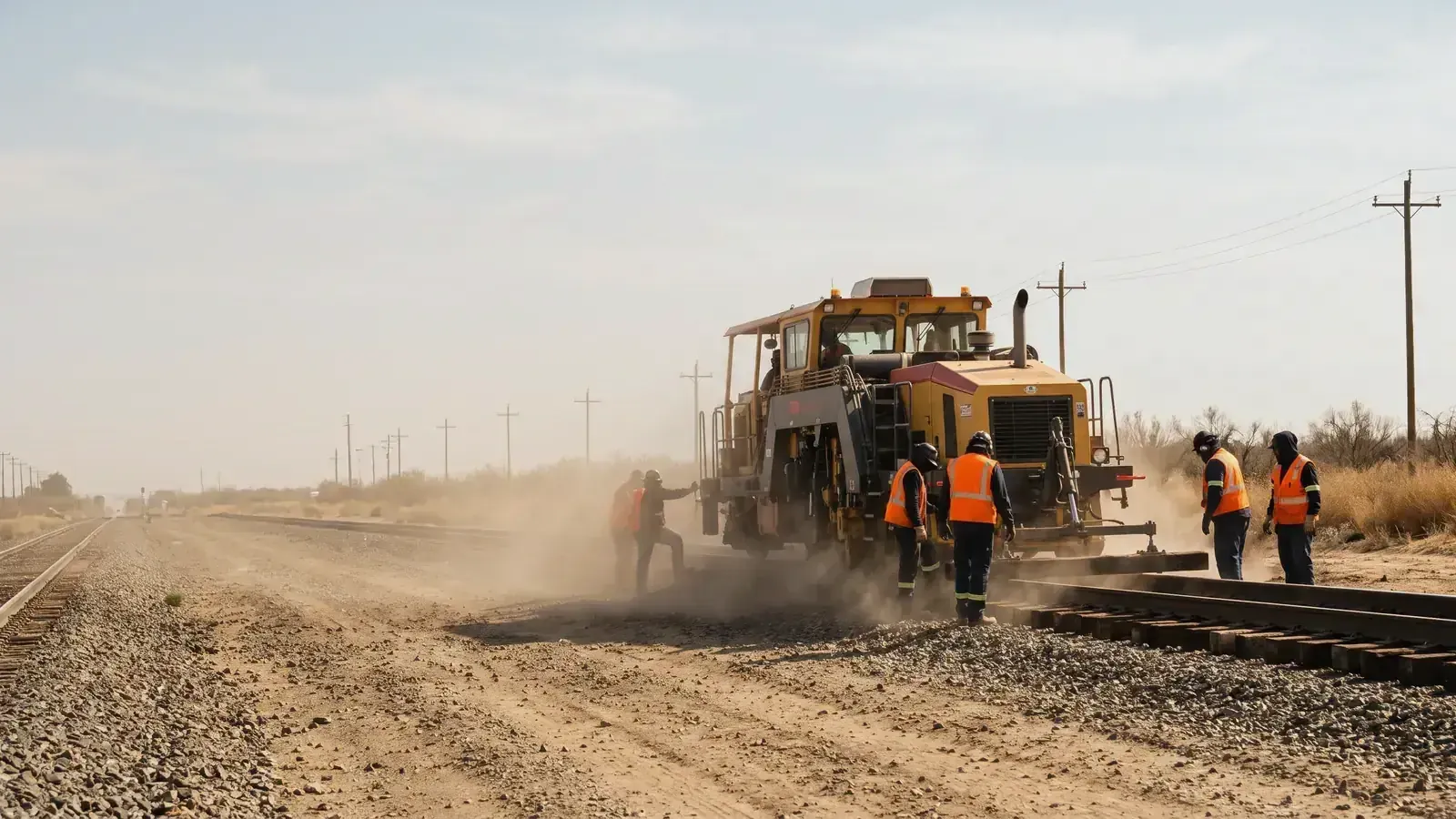
Track crews lay rail, repair it, and keep it in shape in places like service lines, plant yards, quarries, gravel and sand pits, and mines. They run machines that clean and pack the stone under the track, drive spikes and shape the wooden ties, and they tighten the bolts that join the rails. Much of this work happens in ballast and around treated ties, which is where dust and creosote exposures come from.
The preservative soaked into wooden ties is creosote. It is a blend of many chemicals produced from coal or wood; the coal tar form ranks as the most common wood preservative used in the United States. The CDC lists building railroad track with treated wood as one of the ways people are exposed to it.
Long-term exposure to creosote at work has been shown to increase cancer in several parts of the body, including the respiratory tract, skin, lungs, pancreas, kidneys, bladder, rectum, prostate, scrotum, and central nervous system. The federal Department of Health and Human Services lists coal tar and coal tar pitch (the thick tar left after processing) as known causes of cancer in people.
A third worry comes from herbicides sprayed along the right of way. Researchers followed 348 Swedish railroad workers through October 1978 and found more tumor deaths than expected. The extra deaths were highest among workers who had handled two kinds of weed killer together, amitrol and phenoxy acid herbicides. No one tumor type dominated; the study noted three cancers of the stomach and three of the lung.
Silica dust and lung disease
Ballast dust from track work can contain silica, a mineral dust from crushed stone. Workers who breathed that dust for years have gone on to develop silicosis (scarring of the lungs from silica) and other dust-related lung disease.
Back in 1996, a law firm contacted the Occupational Safety and Health Administration regarding railroad workers who had come down with silicosis or mixed dust lung disease after years of track dust. On August 20, 1996, OSHA, the federal workplace safety agency, said its drive against silica dust covered all industries, track work included, and that any worker who thinks he breathes too much of it may complain to the nearest OSHA office. That letter identified track repair and maintenance at railroads like Norfolk Southern and CSX as work with high silica exposure.
In 1949 the Supreme Court said FELA also covers diseases that build up slowly, such as silicosis, not just injuries from sudden accidents. A laborer whose sickness traces back to years of dust gets the same treatment under the law as someone hurt in one moment.
Who does FELA cover?
Your job title does not matter under this law. It covers anyone who works for a railroad that carries goods or people from one state to another, and the railroad has to pay when its carelessness played any part in an injury or a death.
What can a track worker recover under FELA?
FELA stands for the Federal Employers' Liability Act, the statute railroad workers use to claim for injuries and diseases tied to the job. Unlike most workers in America, railroad employees fall outside state workers' compensation systems. Instead, they ask the railroad itself to pay for what they lost.
Those losses cover medical expenses, wages already lost and wages still to be lost, and pain and suffering. Even if you were partly to blame, you can still be paid; the jury lowers the amount to match your part of the blame. If the railroad's carelessness helped cause the harm, it cannot argue that you accepted the risk just by taking the job.
The railroad's negligence does not have to be the only cause. The Supreme Court has said a jury decides the case whenever the railroad's carelessness played any part, even the smallest, in causing the illness. If the worker has died, the person handling his estate, often a family member, brings the claim for his surviving spouse and children.
How much time is there to file a claim?
A FELA suit must be brought within three years of the day the claim arose, and it can go to either federal or state court. For an illness that comes on slowly, the three years start when you learn you are sick and that work may be the cause, not on your last day at work.
The clock can start the day a doctor tells you the illness may be tied to your work, as one recent case shows. A car inspector was diagnosed with bladder cancer in May 2014 and told then that it was connected to his work, but he did not sue until April 2019; in January 2026 a New Jersey appeals court threw out the claim as too late. The court ruled that his claims for the cancer as it existed in 2014 were filed too late.
A recent track foreman lawsuit
On January 15, 2026, a former track foreman sued the Long Island Railroad Company in federal court in New York (case 1:26-cv-00247). He says he was exposed to glyphosate, a weed killer, and diesel fumes, with no training on the chemicals, poor fresh air and too little supervision.
His cancer is in remission (no longer active), but his doctors put the chance of its return at 83 percent. Under FELA, he is asking for more than 200,000 dollars.
Common Questions
Which track jobs pose the greatest cancer risk?
The heaviest exposures come with track repair and maintenance, for silica dust, and with any work that involves building track with creosote-treated ties. In one federal job survey, 22 percent of track workers said they spent every day inside closed vehicles or machines. That alone does not tell how much diesel they breathed.
Can a railroad block a coworker from describing the crew's exposures?
No. Federal law cancels any railroad rule or contract that tries to stop workers from freely sharing what they know about a worker's injury or death.
Does fear of a future cancer matter?
Yes. The Supreme Court ruled that a worker with asbestosis caused by the job can recover for a sincere and serious fear of getting cancer. That worker can also recover complete damages from a railroad whose negligence helped cause the disease.
Call +1 (888) 716-2611 Questions about your own case? Ask in a free FELA claim review by phone, or send the short form