
Railroad solvent exposure and cancer
If you used metal degreasers on the railroad, your exposure to solvents may have included trichloroethylene (TCE), which the National Cancer Institute says can cause kidney cancer. Here you will find which solvents researchers have looked at, what those studies showed, and how a federal law called FELA gives railroad workers and their families a way to pursue compensation from the railroad.
Call +1 (888) 716-2611 Free FELA claim review if this was part of your railroad work
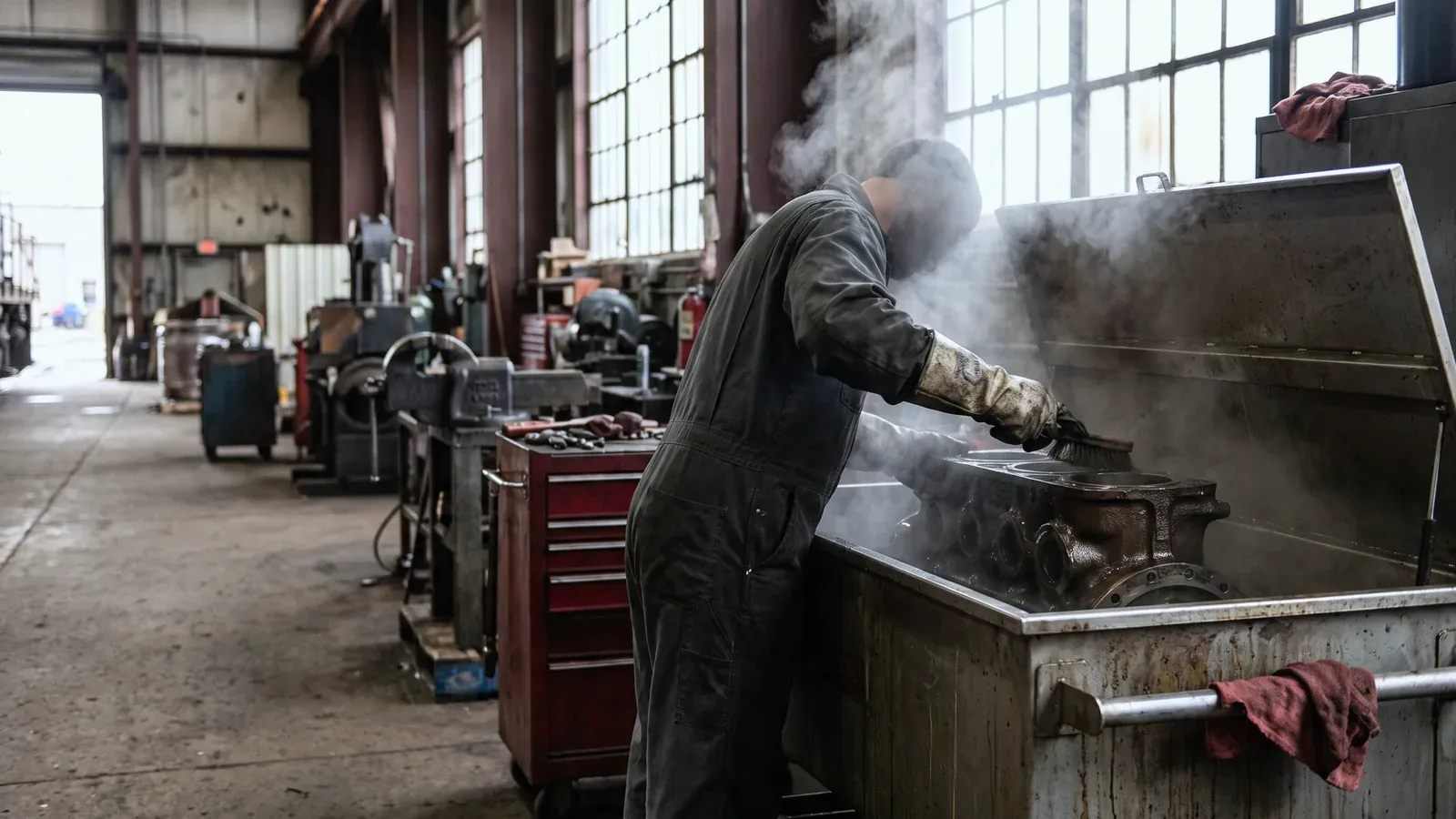
Railroad degreaser exposure
Degreasers are liquids used to strip oil and grease from metal. Trichloroethylene, often called TCE, is a colorless liquid that turns to vapor easily. It is used chiefly to make refrigerants and to degrease metal equipment. People make it; it does not occur naturally.
People who work with TCE can take it in through breathing and through the skin. The US military also relied on it heavily for degreasing equipment. Researchers have also studied solvent exposure in the railroad industry in a 1997 journal article.
Which solvents are tied to kidney cancer?
According to the National Cancer Institute, TCE is a known cause of kidney cancer. IARC reaches the same conclusion. Another cleaning solvent, perchloroethylene, is also suspected of causing cancer.
National Cancer Institute researchers examined six chlorinated solvents in 1,217 people who had kidney cancer and 1,235 who did not. An industrial hygienist, an expert in measuring on-the-job chemical exposure, estimated how much exposure each person likely had to each solvent. Four of the six solvents showed no link to kidney cancer: carbon tetrachloride, chloroform, methylene chloride, and 1,1,1-trichloroethane.
| Solvent, after many hours of exposure over the years | Kidney cancer risk compared with people who weren't exposed | Could the result be chance? |
|---|---|---|
| Perchloroethylene | Roughly triple | Unlikely |
| Perchloroethylene, excluding people likely exposed to TCE | Still roughly triple | Possibly, the result fell just short of the study's bar |
| Trichloroethylene (TCE) | Roughly 1.7 times higher | Possibly, the result was uncertain |
The researchers concluded that heavy perchloroethylene exposure was linked to kidney cancer on its own, not just because people exposed to it were often exposed to TCE too.
Other kidney cancer risk factors
Renal cell carcinoma is the most common form of kidney cancer. The American Cancer Society includes workplace exposure to TCE and to cadmium among possible risks. This cancer shows up about twice as often in men. One reason may be that men have historically spent more time around cancer-causing chemicals on the job.
Other known risks include:
- Smoking, with risk rising the more a person smokes
- Carrying extra body weight
- Elevated blood pressure
- Having a sibling with kidney cancer
- Long-term use of pain medicines such as acetaminophen, which may be linked to a higher risk
- Serious kidney disease, particularly when dialysis is needed
FELA claims for solvent cancer
State workers' compensation covers most on-the-job injuries, but not railroad work. The Federal Employers' Liability Act steps in instead, holding a railroad responsible when an injury or death can be traced even partly to its negligence. Here, negligence means the railroad failed to act with reasonable care. The Supreme Court says FELA covers occupational diseases as well as accidents. The Court has also said even a small contribution from the railroad's negligence can be enough.
If a worker shares some blame, recovery is still possible, though the award is reduced by that share. Damages can cover medical bills, wages lost in the past and future, and pain and suffering. When a worker dies, the estate's personal representative brings the claim on behalf of the worker's husband or wife and children.
Time limit for a railroad cancer claim
A FELA claim has to be filed within three years, in federal or state court, so it helps to check your situation early, before the clock runs out. For a disease that develops slowly, the three years begin when the effects of the exposure become apparent.
That moment can come earlier than people expect. Early in 2026, a New Jersey appeals court let stand the dismissal of a car inspector's claim. His doctor connected his bladder cancer to his work in May 2014, yet he filed in April 2019, past the deadline for the cancer as of 2014.
Questions people ask
Why do railroad injury records almost never mention cancer?
Cancer often takes years to appear after exposure, and by then a worker may have moved on. Most work-related cancers never show up in those FRA injury reports, so a missing report does not mean there is no claim.
Can the railroad keep coworkers from discussing my exposure?
No, it cannot. A rule or contract that tries to block workers from freely passing along information about an injury or death is void.
Can people come into contact with TCE outside work?
Yes, they can. People can encounter it in the air indoors and out, contaminated drinking water, and food rinsed in that water. TCE lingers, travels through soil, and can collect in groundwater. It also turns up in certain tool cleaners and paint strippers.
Did medicine ever use TCE?
Years ago it served as a surgical anesthetic and inhaled pain reliever; the FDA outlawed those uses in the US in 1977.
What goes on during the free claim review?
The review is handled by a law firm that takes FELA cases and advertises on this site. The reviewer will ask which railroads you worked for and when, the jobs you held, and the yards, shops, or lines involved. Expect questions about your diagnosis and when a doctor first linked it to your job. The call might be recorded so the office keeps an accurate work-history record.
Call +1 (888) 716-2611 Questions about your own case? Ask in a free FELA claim review by phone, or send the short form